
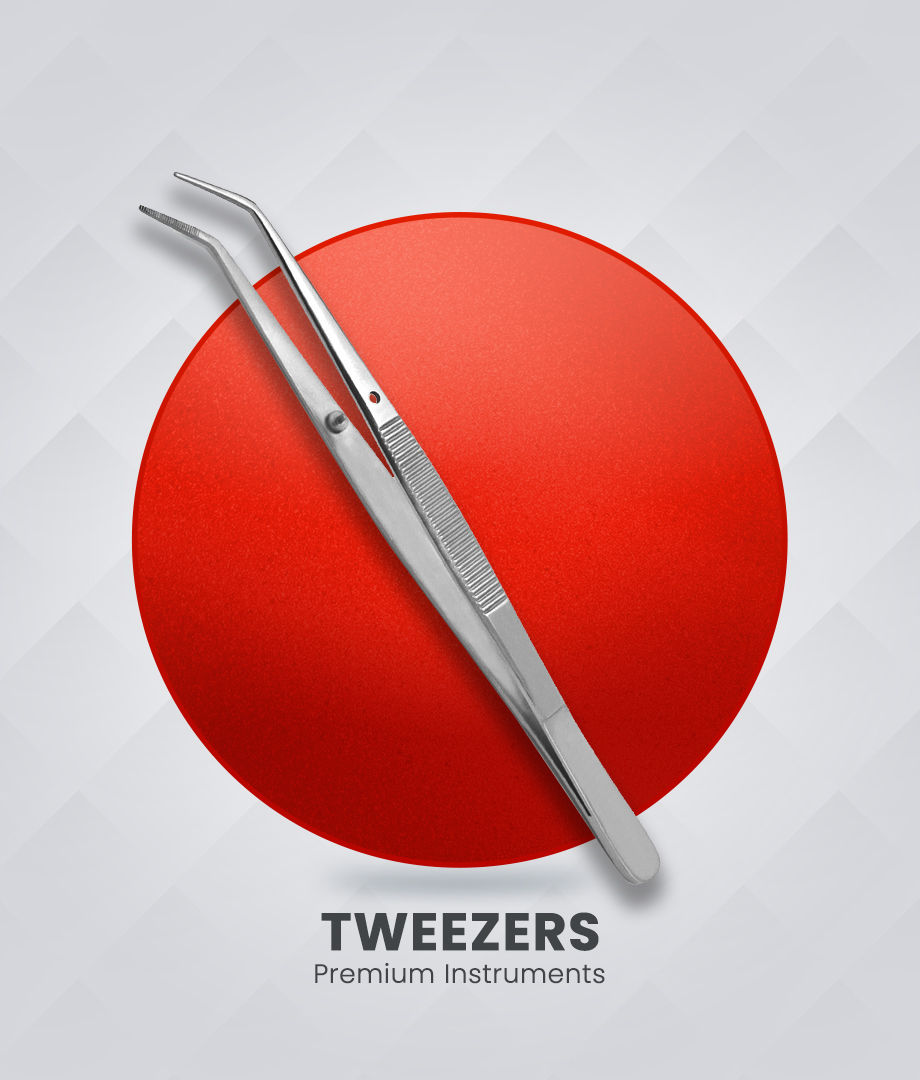
Soar Instruments manufactures Dental Tweezers from high-quality martensitic and austenitic stainless steel grades, including AISI 420 J2 for spring and functional components and AISI 304 for corrosion-resistant applications, in compliance with ISO 7153-1 for metallic materials used in surgical and dental instruments. The material composition is carefully selected to ensure an optimal balance of springback characteristics, hardness, corrosion resistance, and biocompatibility required for repeated clinical use and sterilization cycles. All incoming raw materials are verified through mill certificates and, where necessary, spectrometric analysis to confirm grade conformity prior to production.
The manufacturing process begins with precision forging or bar stock machining of tweezer blanks, followed by CNC machining where required to achieve dimensional accuracy and consistency across all critical features. The working ends, including serrated or smooth beak profiles, are carefully formed and shaped through controlled grinding and forming operations to achieve the required geometry, jaw alignment, and tip precision. Spring arm profiles are formed and calibrated to deliver consistent gripping force and controlled deflection suitable for clinical handling of cotton rolls, dressing materials, and small instruments during dental examination and treatment procedures.
Controlled heat treatment processes, including hardening and tempering, are applied to martensitic components to achieve an appropriate balance of hardness, spring performance, and resistance to permanent deformation during clinical use. Austenitic components are processed to maintain structural integrity and corrosion resistance. Fine grinding, polishing, and finishing operations are carried out to ensure smooth surface transitions, precise jaw geometry, and accurate jaw closure alignment across all instruments.
Surface finishing is performed through mirror polishing or satin finishing according to customer requirements, with controlled surface roughness to enhance cleanability, reduce bacterial retention, and improve user comfort during prolonged clinical procedures. Passivation is conducted using nitric or citric acid solutions in accordance with ASTM A967 or ASTM A380 to improve corrosion resistance and remove surface contaminants introduced during the manufacturing process. Cleaning is carried out using ultrasonic systems, followed by rinsing with deionized water and drying in a controlled environment to ensure complete removal of residues. Laser marking is applied on each instrument for permanent identification, including company logo, instrument pattern, and batch or lot number to ensure full traceability throughout the product lifecycle.
Each Dental Tweezer undergoes strict quality control procedures, including 100% visual inspection, dimensional verification, functional checks such as jaw alignment, spring tension, tip closure accuracy, and surface finish evaluation, to ensure consistent performance and reliability across production batches. Instruments are supplied in a non-sterile condition and are designed to withstand repeated steam sterilization cycles at temperatures up to 134°C, ensuring compatibility with standard hospital and clinic reprocessing procedures, including enzymatic cleaning and ultrasonic washing.
Manufacturing and quality management systems comply with ISO 13485 requirements for medical devices. The instruments meet applicable regulatory requirements, including CE marking under EU MDR 2017/745 as Class I reusable surgical instruments and UKCA marking under United Kingdom medical device regulations. Where applicable, compliance with United States FDA requirements (21 CFR Part 820) is maintained. Biocompatibility considerations are aligned with ISO 10993 standards for patient-contact materials. Labeling, packaging, and traceability systems, including batch or lot identification and, where required, Unique Device Identification (UDI), are implemented in accordance with regulatory requirements. Packaging is performed in controlled clean conditions using protective materials such as polybags, pouches, or blister packs, ensuring product integrity during storage and transportation.


Reviews
There are no reviews yet.